
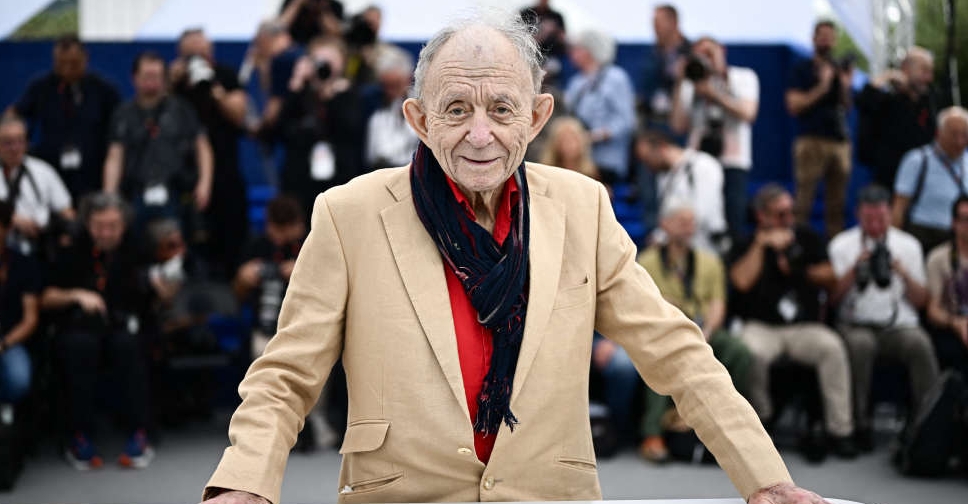
American filmmaker Frederick Wiseman, who had a six-decade career documenting dozens of institutions across the US, died on Monday at the age of 96, according to a statement by Zipporah Films, the distribution company he founded.
No cause was immediately given on his death.
Creating some 50 films, Wiseman was an observer. His films eschew an explanatory voice-over; people don't sit down for interviews with flattering lighting; when there's music, it's in the scene, not added later.
His cameras captured reality; 200 hours of raw material was not unusual, which an editor, typically Wiseman himself, then distilled into a feature film.
"The audience is placed in the middle of these events and asked to think through their own relationship to what they are seeing and hearing," Wiseman told Documentary Magazine in 1991. "They are asked to ask themselves why I have selected and arranged the material in this particular form."
His documentaries did not receive wide releases; none were box office hits. Besides an occasional airing on public television, audiences had to seek them out at festivals, college campuses or independent cinemas.
Funding was never assured. Wiseman turned to the crowdfunding platform Kickstarter for In Jackson Heights, about New York's multicultural neighbourhood, but the campaign fell short of its modest goal of $75,000.
The film did ultimately get made, in 2015, and attracted some of the best reviews of Wiseman's career. Critic Matt Zoller Seitz called it "warm and attentive".
His work belongs to a genre sometimes known as "direct cinema" - analogous to the French "cinéma vérité".
Enthusiasts compared his films to penetrating novels. "Nobody talks seriously about writing the Great American Novel anymore, but Wiseman belongs to a generation that used to, and his body of work... represents the nearest contemporary equivalent I can think of," writer Mark Binelli argued in the New York Times Magazine in 2020.
Wiseman called his documentaries "reality dreams" and "expressions of my curiosity".
'TO CAPTURE WHAT'S GOING ON IN THE WORLD'
Frederick Wiseman was born on New Year's Day in 1930, in Boston, the only child of parents Jacob Leo Wiseman, an attorney who emigrated from Russia to the US, and Gertrude (née Kotzen), an administrator at the psychiatry department of a children’s hospital. He studied and later taught law.
He also served in the US Army, "fortunately", after the end of the Korean War, he told Britain's Daily Telegraph, before turning to filmmaking.
His first feature, Titicut Follies, released when he was 37, took viewers inside a Massachusetts prison-hospital for the criminally insane. Though it could not be shown outside academic settings for decades because of a legal dispute with the state, the film helped establish Wiseman's observational approach. "It seemed to me an appropriate style to use when I was trying to make films about real situations, where I wasn’t asking people to do anything especially for me," Wiseman said in 2016. "The idea always has been to capture as many different aspects of what’s going on in the world as I can on film."
In 1968's High School, his camera followed teens and their teachers in Philadelphia at a time of social upheaval. Like Follies, it is part of the National Film Registry at the Library of Congress. High School II followed in 1994, shot in New York City.
PBS broadcast his third film, Law and Order, about Kansas City cops, as well as Domestic Violence, in 2001, about a women's shelter.
'WORKING KEEPS ME OFF THE STREETS'
Wiseman received an honorary Oscar in 2016. His "masterful and distinctive documentaries examine the familiar and reveal the unexpected," the Academy citation read.
"Constantly working keeps me off the streets," he joked when accepting the Oscar. "This compulsion has always been understood by my wife, Zipporah, and my sons, David and Eric." He named his production company after Zipporah, a law professor who died in 2021.
Other honours included four Emmys and recognition from the Cannes, Berlin, and Venice film festivals, as well as MacArthur and Guggenheim fellowships.

 Grammy-winning artist Richard Marx heads to Dubai for debut act
 Robert Duvall, 'Tender Mercies' Oscar winner, dies at 95
 Ambitious TV adaptation of Allende's 'House of the Spirits' premieres in Berlin
 English museum shines light on Mary Shelley and her Gothic classic 'Frankenstein'
 Sci-fi film 'Good Luck, Have Fun, Don't Die' warns of AI, with a comic twist