
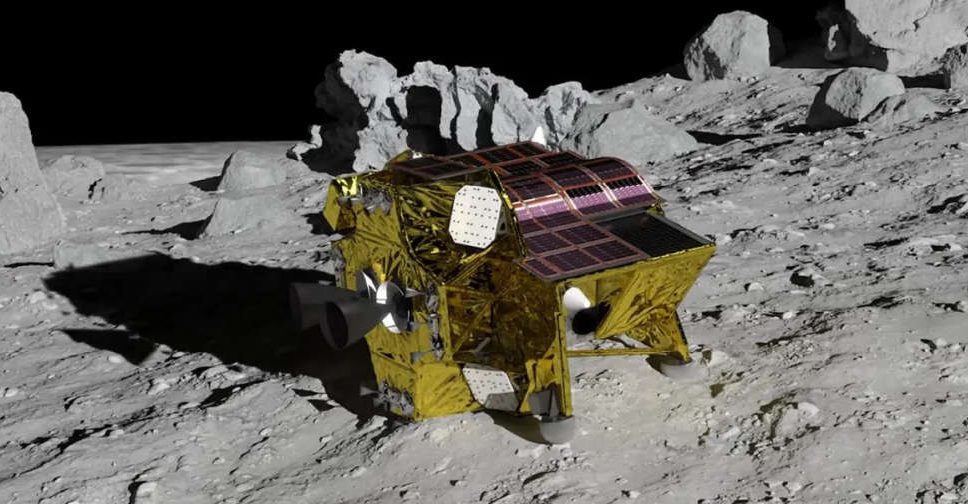
Japan became the fifth country to put a spacecraft on the moon but the probe was not generating solar power, its space agency said, during a mission to prove a "precision" landing technology.
The Japan Aerospace Exploration Agency (JAXA) said its Smart Lander for Investigating Moon (SLIM) landed the moon's surface at around 12:20 am (1520 GMT Friday) and re-established communication with earth, but its solar panels were not able to generate electricity, possibly because they are angled wrong.
"SLIM is now operating only on its battery, and we are prioritising the transfer of its data onto earth", Hitoshi Kuninaka, the head of JAXA's space lab, told a press conference.
Dubbed the "moon sniper", SLIM attempted to land within 100 metres (328 feet) of its target, versus the conventional accuracy of several kilometres, a technology JAXA says will become a powerful tool in future exploration of hilly moon poles seen as a potential source of oxygen, fuel and water.
It will take up to a month to verify whether SLIM had achieved the high-precision goals, JAXA has said.
Japan is increasingly looking to play a bigger role in space, partnering with ally the United States to counter China. The country is also home to several private-sector space startups and the JAXA aims to send an astronaut to the moon as part of NASA's Artemis programme in the next few years.
But the Japanese space agency has recently faced multiple setbacks in rocket development, including the launch failure in March of its new flagship rocket H3 that was meant to match cost-competitiveness against commercial rocket providers like SpaceX.
The failure caused widespread delays in Japan's space missions, including SLIM and a joint lunar exploration with India, which in August made a historic touchdown on the moon's south pole with its Chandrayaan-3 probe.
JAXA has twice landed on small asteroids, but unlike with an asteroid landing, the moon's gravity means the lander cannot pull up for another try, its scientists said.
Three lunar missions by Japanese startup ispace, Russia's space agency and American company Astrobotic have failed in the past year.
Only four nations - the former Soviet Union, the United States, China and India - and no private company have achieved a soft landing on the moon's surface.


 Jordan arrests 3 over Karak church attack, state TV says
 Brazil's working class president Lula wins historic fourth term
 Two injured from falling debris as missiles intercepted in Saudi Arabia
 Venezuela opposition leader Machado returns to country