
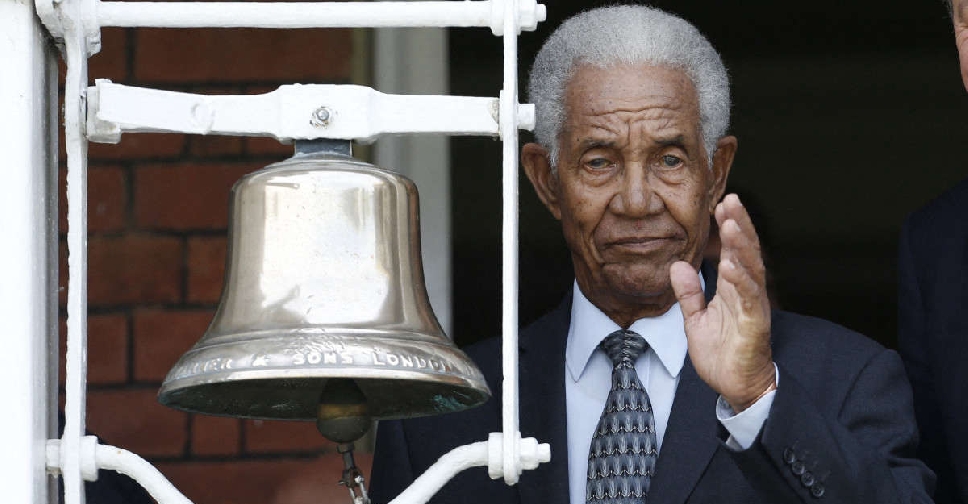
West Indies cricket great Sir Garfield Sobers, widely regarded as the sport's greatest all-rounder, has died at the age of 89.
West Indies Cricket announced his death on Friday. No cause was given.
Known for his aggressive top-order batting, the ability to bowl medium fast and spin, and excellent fielding, Sobers represented West Indies in 93 tests in an international career spanning two decades, from 1954 to 1974.
He scored 26 centuries, and his knock of 365 not out against Pakistan in 1958 was the highest individual score in a test innings until Brian Lara broke his record in 1994.
A great innings has come to an end. In our hearts, now and forever, Sir Garfield Sobers. 🖤🏏 pic.twitter.com/bv2MO1SJgz
— Windies Cricket (@windiescricket) July 17, 2026
A graceful and destructive left-handed batsman, a left-arm bowler equally skilled at delivering pace and spin, and a brilliant fielder in any position, Sobers was named one of the five leading cricketers of the 20th century by the sport's Wisden Almanack.
He came second only to prolific Australian batsman Don Bradman, who himself said of the player in 1988: "I've got no hesitation at all in saying that Garry Sobers is the greatest all-round cricketer I ever saw."
Reflecting on his achievements, Sobers often played down the importance of his natural talent. "People call me a genius. I don't know much about geniuses," he said late in his life.
"But I do believe that what I achieved was not just because of the ability that I was born with but also because I worked hard."
Garfield St Aubrun Sobers was born in St Michael, Barbados, on July 28, 1936, the fifth of six children of Shamont and Thelma Sobers.
His father, a seaman working in the Canadian merchant navy, died when German forces sank the boat on which he was serving. Garfield was five years old.
His mother rose to the task of raising the children by herself. "She did whatever she had to do and looked after us tremendously well," Sobers wrote in his autobiography.
"We went to school, we were clean, we had shoes on our feet and food in our bellies."
Sobers excelled at many sports, including football and basketball, but cricket was his passion. His first memories of the sport were of playing in the road or on the beach, aged eight.
At first he played 'Lilliputian cricket', which required little space and a wicket less than half the normal size. The ball would be fashioned from a lump of tar, the bat from a piece of fence.
If the sun melted the tar ball, a rock wrapped in cloth would serve as a replacement.
When the West Indies team toured India in 1948, and England two years later, Sobers listened in awe to the radio commentaries.
"To a young boy from a humble background, this was something magical," he recalled in his autobiography. "It was a wondrous thing to think that if I could develop my skills enough, I might have that same opportunity."
Sobers made his first-class debut for Barbados at 16.
He played his first test for West Indies in 1954. At 21, he scored his maiden hundred against Pakistan, finishing on 365 not out, then the highest individual test innings.
He remains the youngest test triple-centurion.
'HE'S DONE IT!'
Sobers took over as West Indies captain in 1965, before joining English County Nottinghamshire. He was batting for them in 1968 when he became the first player to hit six sixes in one over in first-class cricket.
Glamorgan medium-pacer Malcolm Nash was the unfortunate bowler as Sobers launched his first four deliveries out of the ground before he was caught in the deep off the fifth.
In taking the catch, however, the fielder fell on to the boundary rope. The umpire ruled that the ball was over the line and signalled a six.
Sobers coolly struck the next delivery over the East Terrace of St Helen's, the Welsh cricket ground.
"And he's done it! He's done it! And my goodness, it's gone ... way down to Swansea!" exclaimed radio commentator Wilf Wooller.
Sobers preferred to focus on how his innings had helped his team win the match.
"Six sixes are not good cricket," he said after his feat received worldwide acclaim. "It was an occasion where we were looking for quick runs. The idea was to try and get as many runs as possible.
"Records must not be the focus and that's the most important thing," he added. "It mustn't come at the cost of the team."
In 383 first-class matches, Sobers made more than 28,000 runs and took more than 1,000 wickets.
'I WASN'T BOTHERED'
In 1970, he played cricket in apartheid Rhodesia (now Zimbabwe), generating an international backlash.
Sobers was particularly condemned in the Caribbean, where calls grew for him to be sacked as West Indies captain.
"I had not realised the deep feelings of the West Indian people in this issue of Rhodesia," he reacted in a letter to the West Indies Cricket Board. "If I had known or thought of these matters, I would never have gone to Rhodesia."
Sobers retained the captaincy.
He received several invitations to play in apartheid South Africa but refused them all, he wrote in his memoir.
In 1991, as the country's system of racial segregation ended, he briefly met Nelson Mandela, who named him and Bradman as his favourite cricketers.
Sobers called Mandela "a truly great man". He went on to denounce the discrimination that he and other Black players had endured in Barbados as well as in England.
In 1975, he was knighted for his services to cricket by Queen Elizabeth II in an open-air ceremony in Bridgetown, Barbados, that reportedly drew 50,000 spectators.
He was named as one of the 10 official National Heroes of Barbados in 1998. The Sir Garfield Sobers Sports Complex was built there as a venue for major sporting and cultural events.
"There are those who claim I was destined to do well in life because I arrived in this world with two extra fingers, as though there was something mystic about it," Sobers recalled. "I wasn't bothered. They didn’t inhibit me in any way at all."

 F1 commission agrees to shorter races from 2027
 Spain extend coach Luis de la Fuente to 2032
 Infantino says he is open to talks over FIFA reform
 Troubled Marseille lose fifth straight as PSG win